Childhood in Walsum
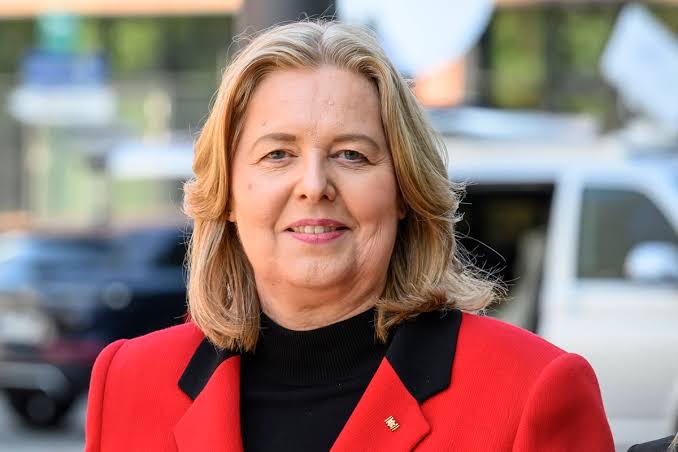
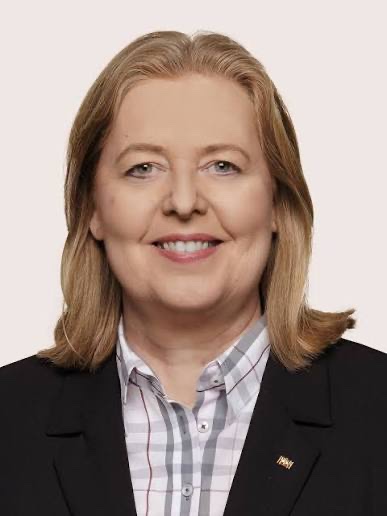
Bärbel Bas was born on 3 May 1968 in Walsum, a town on the right bank of the Rhine at the northern edge of the Ruhr. Walsum had its own coal mine and power station and was an independent municipality until 1975, when it was incorporated into the city of Duisburg.1 She has remained rooted in Duisburg ever since; it is the city she has represented in the Bundestag for seventeen years.
Little about her family background is documented in official sources, and this biography does not speculate about it. What is on record is the setting: an industrial district in a region whose economy was then dominated by coal, steel and the logistics of the Rhine.
Education
She attended a Hauptschule — the most vocationally oriented track of West Germany’s three-tier school system — and in 1984 left with the Hauptschulabschluss together with the Fachoberschulreife, the qualification that permits entry to a technical secondary school.2 She did not go on to university. Her later qualifications were all acquired alongside work, through vocational and professional training.
Apprenticeship
From 1985 to 1987 she trained as an office clerk (Bürogehilfin) at the Duisburger Verkehrsgesellschaft (DVG), the city’s municipal bus and tram operator. She then worked at DVG as a clerk (Sachbearbeiterin) from 1987, later moving to the company health insurance fund, the Betriebskrankenkasse DVG, where she stayed until 2001.2
Employee representation
Her first elected position came a year into her apprenticeship. From 1986 to 1988 she was a member of the Jugend- und Auszubildendenvertretung, the statutory body that represents young employees and trainees within a German company. From 1988 to 1998 she sat on the DVG works council and served as an employee representative on the company’s supervisory board.2
German co-determination law gives these bodies real rights: works councils must be consulted on hiring, dismissals, working hours and many organisational questions, and employee representatives on supervisory boards vote on the appointment and oversight of management. For a decade, then, she was part of how a public company with several thousand employees was run.
Social insurance and management
Working in the company health fund drew her into the social-insurance system itself. Between 1994 and 1997 she trained as a Sozialversicherungsfachangestellte (social-insurance specialist); from 2000 to 2002 she completed part-time further training as a Krankenkassenbetriebswirtin (health-insurance business administrator), and in 2003 obtained the trainer qualification.2
From 2002 to 2006 she was deputy member of the executive board of BKK EVS, a company health insurance fund. Between 2005 and 2007 she studied in the evenings to qualify as a Personalmanagement-Ökonomin (VWA), a diploma in personnel management. From 2007 until her election to the Bundestag in 2009 she headed the personnel services department at BKK futur.2
Local politics
She joined the SPD in October 1988, the same year she was elected to the works council.3 She became active in the party’s youth organisation, the Jusos, and chaired the Duisburg Jusos in the 1990s. From 1994 to 2002 she was a member of Duisburg City Council.3 She later held positions in the SPD’s Duisburg sub-district, the Lower Rhine regional organisation and the RuhrSPD, and since 2010 has chaired the party council of the SPD in North Rhine-Westphalia.4
Bundestag
At the 2009 federal election she won the Duisburg I constituency directly — in an election in which the SPD nationally fell to 23 per cent, its worst result in the post-war era up to that point. She has held the constituency at every election since: 2013, 2017, 2021 and 2025.5 In her first term she sat on the Health Committee, building on her professional background in statutory health insurance.
Bundestag career Election record
Parliamentary leadership
In December 2013 she became one of the Parliamentary Executive Directors (Parlamentarische Geschäftsführerin) of the SPD parliamentary group — the managers who organise a group’s business, negotiate the plenary agenda with other groups and keep its members informed and in line. In September 2019 she was elected Deputy Chair of the group, responsible for health, education and research, and petitions, a post she held until 2021.4 In that role she was among the SPD’s parliamentary voices on health policy during the first phase of the COVID-19 pandemic.
Bundestag presidency
On 26 October 2021, at the constituent sitting of the 20th Bundestag, she was elected President with 576 of 724 votes; 90 members voted against and 58 abstained.6 She was the third woman in the office, after Annemarie Renger (1972–1976) and Rita Süssmuth (1988–1998), and the fourteenth President of the Bundestag.7
In her inaugural speech she promised to work for “a new closeness to citizens”. Her term coincided with Russia’s full-scale invasion of Ukraine, the energy crisis, the Hamas attack on Israel and a rise in pressure on democratic institutions; it ended prematurely with the early election of February 2025. Her presidency closed on 25 March 2025, when the new Bundestag elected Julia Klöckner.
Federal government
On 6 May 2025 she was appointed Federal Minister for Labour and Social Affairs in the coalition government of CDU, CSU and SPD led by Chancellor Friedrich Merz, succeeding Hubertus Heil.8 Her first eighteen months in office brought the 2025 pension package, the Aktivrente, the replacement of Bürgergeld by a new basic income support, a federal collective-bargaining compliance law and the commissioning of reports on the future of the welfare state and of old-age provision.
SPD leadership
Following the SPD’s result of 16.4 per cent in the February 2025 election, Saskia Esken did not stand again as co-chair. On 27 June 2025 the party congress elected Bas as co-chair alongside Lars Klingbeil with 95.0 per cent of the vote.9
Personal
Bas was married to Siegfried Ambrosius, a long-standing Duisburg SPD figure, who died in 2020.4 She keeps her private life largely out of public view, and this archive records only what she or reliable sources have made public.