Germany’s social state is older than the Federal Republic itself. Understanding Bärbel Bas’s ministry begins with understanding the system it runs — and the parts of it that belong to other ministries.
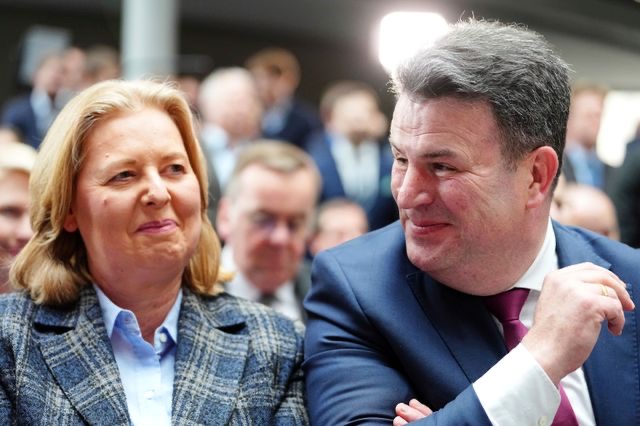
HandoverWith Hubertus Heil, her predecessor as Federal Minister for Labour and Social Affairs (2018–2025).
§ 01The architecture
Who is responsible for what
The five branches of social insurance are financed mainly by contributions from employees and employers and run by self-governing bodies under state supervision. The table shows the lead federal ministry for each.
Lead federal responsibility as of 2026. Long-term care and health are not part of the Labour Ministry’s portfolio.
Branch
Founded
Financing
Run by
Lead ministry
Health insurance
1883
Contributions, federal subsidy
Statutory health funds
Health (BMG)
Accident insurance
1884
Employer contributions
Employers’ liability insurance associations
Labour (BMAS)
Pension insurance
1889
Contributions (18.6% in 2026), federal subsidy
Deutsche Rentenversicherung
Labour (BMAS)
Unemployment insurance
1927
Contributions
Federal Employment Agency
Labour (BMAS)
Long-term care insurance
1995
Contributions
Care funds at the health funds
Health (BMG)
Basic income support (tax-funded)
2005
Federal and municipal budgets
Job centres
Labour (BMAS)
Social assistance (tax-funded)
1962
Municipal budgets, federal share
Municipal social offices
Labour (BMAS)
Child benefit & family benefits
—
Tax
Family benefits offices
Finance / Family
Contributions
Employees and employers pay a share of wages into the insurances while people are in work.
Social security
Protection
Benefits flow back when work stops — through illness, accident, unemployment, disability or age.
§ 02Branch by branch
The state of each system in 2026
Pensions
Stabilised to 2031, reform pending
The 2025 pension package fixed the pension level at 48 per cent until 2031. Pensions rose by 4.24 per cent on 1 July 2026. The pension commission’s 33 recommendations of June 2026 are the basis of a reform the government has promised to legislate.1Pension policy
Unemployment
Rising claims in a weak economy
With unemployment near three million, the Federal Employment Agency’s finances are under strain. Unemployment insurance also funds short-time work, which cushions industrial job losses.
Basic income support
The new Grundsicherung
In force since 1 July 2026. Benefit cuts of 30 per cent for failing to take part in measures, full loss of the standard benefit after three consecutive missed appointments, priority for placement, abolition of the asset grace period.2Major initiatives
Accident insurance
Prevention at work
The statutory accident insurance covers accidents at work and occupational diseases and finances prevention in companies — a field directly linked to the ministry’s occupational-safety responsibility.
Disability
Participation law
The Federal Participation Act and the Disability Equality Act fall within the ministry. A reform of the latter is in parliamentary deliberation in 2026. Equality & participation
Reform
Simplifying the system
The Social State Commission’s January 2026 report proposed merging basic income support, housing benefit and the child supplement into one system with one digital portal. Digital welfare state
§ 03 · Approach
Bas’s political position
Bas’s public line has two parts that her supporters see as balanced and her critics as contradictory.
The first is a defence of the welfare state against the argument that Germany can no longer afford it. In late August 2025, at a conference of the North Rhine-Westphalian Jusos, she called that debate — in a word she apologised for in advance — “Bullshit”.3 When the Social State Commission reported in January 2026, she promised reform “without benefit cuts”.4
The second is a demand for reciprocity from benefit recipients, expressed in the stricter rules of the new Grundsicherung — the reform that much of her own party’s youth organisation opposed.
„Die, die nicht mitmachen, müssen das auch merken.“
“Those who do not cooperate must also feel it.”
Her own professional background lies in social insurance administration — contributions and benefits as everyday work rather than abstraction. This archive does not judge which strand of her policy will prevail; it records both.
Sources
Federal Ministry of Labour and Social Affairs, cabinet decision on the 2026 pension adjustment. bmas.de
Federal Ministry of Labour and Social Affairs, “Neue Grundsicherung”. bmas.de
heidelberg24, report on Bas’s speech to the NRW Jusos, Aug 2025. heidelberg24.de
Legal Tribune Online, Social State Commission report, 27 Jan 2026. lto.de
German Bundestag, labour and social budget debate, 26 Sept 2025. bundestag.de