Duisburg & the Ruhr

Where the Ruhr meets the Rhine

Duisburg is a city of steel, river and port — and of the social questions that come with industrial change. It is also the only constituency Bärbel Bas has ever represented.

Schematic line map of Duisburg A schematic, not-to-scale diagram showing the Rhine running north to south through Duisburg, the Ruhr joining from the east, and Walsum, Hamborn, Meiderich, Ruhrort, Duisburg-Mitte, Rheinhausen and Duisburg-Süd as stations. RHEIN RUHR Walsum · 1968 Hamborn Meiderich Ruhrort · port Duisburg-Mitte Rheinhausen Duisburg-Süd
Schematic · not to scale · selected districts

§ 01The city

Steel, river, port

≈ 500,000inhabitants — one of the larger cities of North Rhine-WestphaliaCity of Duisburg, population statistics
7city districts, including Walsum since 1975City of Duisburg
2federal constituencies: Duisburg I and Duisburg IIFederal Returning Officer

Duisburg grew where the Ruhr flows into the Rhine. Its harbour, centred on Ruhrort, became the main transshipment point for the coal and steel of the Ruhr basin and is today one of the largest inland ports in the world. Integrated steelworks in the north and west of the city still make Duisburg Germany’s most important steel location.

That industrial base has been under pressure for half a century. Coal mining in the city ended with the closure of the last pits, among them the Walsum colliery in 2008. Steel employment has fallen with every restructuring round, and in 2025–26 the future of the city’s largest steel producer was again the subject of national debate about energy costs, hydrogen-based production and state support.

The social consequences are visible in the statistics: Duisburg has for many years had an unemployment rate well above the national average and a high share of residents receiving basic income support. Large parts of the population have a migration history, reaching back to the recruitment of guest workers for mines and steelworks in the 1950s–70s and continuing with more recent immigration from south-eastern Europe and from refugee movements.

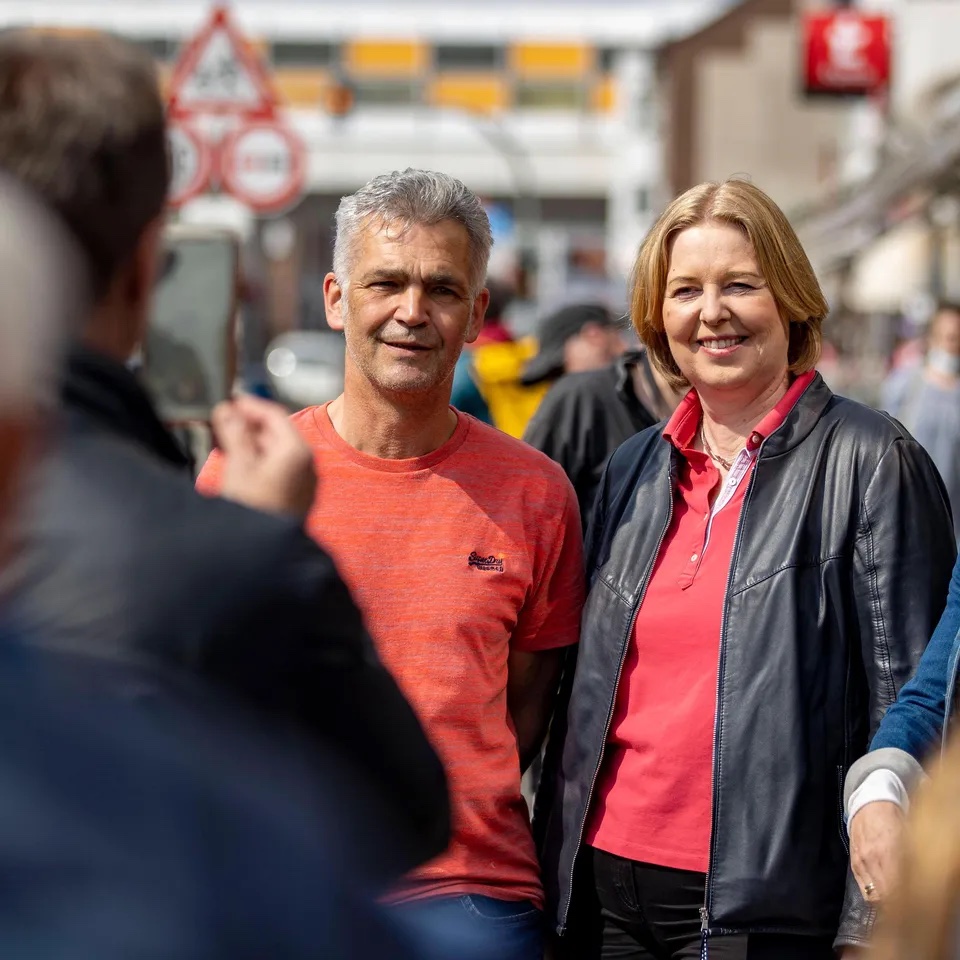
Bärbel Bas, smiling in a black leather jacket and pink shirt, standing on a busy shopping street next to a man in an orange T-shirt
DuisburgOut in the constituency: Bärbel Bas on a shopping street in Duisburg.

§ 02Issues

Six local questions with national weight

The issues below are the city’s, not a portrait of Bas. Where they connect with her documented political work, the link is stated.

Industrial transformationSteel

Keeping industrial work

The shift to low-carbon steel production decides the future of thousands of jobs in the city. Labour-market policy, short-time work and retraining are federal levers that touch it directly — the remit of her ministry.

EmploymentLabour market

Long-term unemployment

Persistent unemployment and benefit dependency make Duisburg a test case for job-centre policy. The 2026 basic income support reform, with its emphasis on placement, is debated here in concrete terms.

MigrationIntegration

Arrival city

Duisburg has long received labour migrants and refugees. Language, recognition of qualifications and access to work are the practical questions; labour-market integration is a federal Labour Ministry task.

InfrastructurePort & transport

Bridges, port, rail

As a logistics hub, Duisburg depends on bridges, rail links and waterways. DVG, her first employer, remains the city’s public transport operator.

HealthCare access

Health in a working city

Life expectancy and health outcomes vary sharply between districts in Ruhr cities. Health policy was her first specialism in the Bundestag.

EducationSchools & training

From school to apprenticeship

Transitions from school into vocational training are decisive in a city with many young people without qualifications. Education & skills

§ 03 · Connection

A constituency MP, even at the top

Bas has held the Duisburg I constituency directly since 2009, at five consecutive federal elections.1 She has stood in no other constituency. Even as Bundestag President, the highest-ranking member of Parliament, she remained a constituency MP for Duisburg.

In her inaugural speech as President in October 2021 she made that local tie explicit: “Ich verspreche, meine Stadt nicht aus dem Blick zu verlieren” — “I promise not to lose sight of my city.”2

It would be too much to say that Duisburg explains her politics. It is fair to say that the subjects of her current ministry — industrial jobs, long-term unemployment, integration into work, pensions in a region of former miners and steelworkers — are everyday matters in the city she represents.

Election record in Duisburg I

Sources

  1. The Federal Returning Officer, constituency results Duisburg I, 2013–2025. bundeswahlleiterin.de
  2. Bärbel Bas, inaugural speech as Bundestag President, 26 Oct 2021. bundestag.de
  3. City of Duisburg, statistics and districts. duisburg.de
  4. duisport — Duisburger Hafen AG, company information. duisport.de