Party & public life · Initiatives 2025–2026

Eight files from the Labour Ministry

Each file below follows the same structure: the problem, the policy, who it affects, the expected impact, the criticism and the current status. Expected impacts are those claimed by the government or estimated by named institutions — not outcomes already observed.

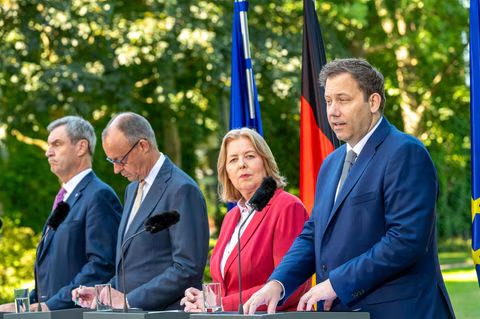
Markus Söder, Friedrich Merz, Bärbel Bas and Lars Klingbeil standing at lecterns outdoors in front of German and EU flags at a press conference
CoalitionCoalition leaders Markus Söder (CSU), Friedrich Merz (CDU), Bärbel Bas and Lars Klingbeil (SPD) at a joint press conference.
File 01 · Pensions

Pension package 2025 (Rentenniveaustabilisierungsgesetz)

In force 1 Jan 2026
The problemWithout legislation the pension level would have fallen below 48 per cent of average earnings as baby-boomers retire.
The policyPension level held at 48 per cent until 1 July 2031; Mütterrente III from 2027; removal of the ban on re-employing former employees past retirement age.
Who it affectsCurrent and near-retirement pensioners; parents (mostly mothers) of children born before 1992; contributors who finance it.
Expected impactPensions about one point higher than otherwise after 2031, at a cost estimated up to €15bn a year.
CriticismThe CDU/CSU “Junge Gruppe” objected to the long-term costs; 7 Union MPs voted no. Economists questioned sustainability.
Current statusPassed 5 Dec 2025 (318 votes), Bundesrat 19 Dec 2025, in force.
File 02 · Older workers

Aktivrente

In force 1 Jan 2026
The problemSkilled workers leave the labour market at retirement age while shortages grow.
The policyUp to €2,000 a month (€24,000 a year) earned by employees beyond statutory retirement age is tax-free.
Who it affectsEmployees past retirement age; not the self-employed.
Expected impactMore people working longer voluntarily; government cites relief for shortage occupations.
CriticismExcludes the self-employed; deadweight effects for those who would have worked anyway; questions of fairness to younger taxpayers.
Current statusPassed Dec 2025, in force.
File 03 · Basic income support

From Bürgergeld to the new Grundsicherung

In force 1 Jul 2026
The problemPublic acceptance of Bürgergeld had fallen; the coalition agreed to reform it towards faster placement.
The policy30% cuts for missing measures; full loss of the standard benefit after three missed appointments; placement priority; asset grace period abolished; housing-cost caps.
Who it affectsAbout 3.7 million people eligible for basic income support (Sept 2026), and job centres.
Expected impactMore transitions into work; government also expects savings. No outcome data yet.
CriticismGreens and Left: sanctions counterproductive; welfare associations cite the 2019 Constitutional Court ruling; a Juso-led SPD member petition opposed it.
Current statusBundestag 5 Mar 2026 (roll call: about 320 yes, 268 no), Bundesrat 27 Mar, in force 1 Jul 2026.
File 04 · Collective bargaining

Bundestariftreuegesetz

Passed 26 Feb 2026
The problemFalling collective-bargaining coverage; public contracts can reward firms that pay below agreed wages.
The policyFederal contracts above €50,000 (€100,000 for civil protection and security) require pay and conditions under collective agreements. Supplies and Bundeswehr orders exempt until 2032.
Who it affectsCompanies bidding for federal contracts and their employees.
Expected impactHigher pay in contracted work; fairer competition for bargaining-bound firms.
CriticismEmployers: more bureaucracy. Greens: thresholds and exemptions leave around 30% of contracts out. AfD voted against; Left abstained.
Current statusPassed with CDU/CSU, SPD and Greens.
File 05 · Wages

Minimum wage €13.90 / €14.60

In force 1 Jan 2026
The problemLow pay in services and in-work poverty; EU minimum wage directive reference values.
The policyImplementation of the Minimum Wage Commission’s recommendation: €13.90 from 2026, €14.60 from 2027.
Who it affectsMore than six million workers, according to the government.
Expected impactWage gains at the bottom of the distribution; knock-on effects on wage scales.
CriticismSmall businesses and some sectors warn of job losses and price rises.
Current statusOrdinance of Nov 2025; first stage in force.
File 06 · Welfare-state reform

Social State Commission and its follow-up

Recommendations
The problemA fragmented system: several overlapping means-tested benefits run by different authorities.
The policy26 recommendations (27 Jan 2026): merge basic income support, housing benefit and child supplement; reduce four authorities to two; one portal; automatic child benefit.
Who it affectsLow-income households, families, municipalities and job centres.
Expected impactSimpler access and better take-up; Bas has pledged no benefit cuts.
CriticismMunicipalities fear new burdens; data-protection concerns; doubts about delivery timelines.
Current statusConcept due autumn 2026; laws by end of 2027. Automatic child benefit: cabinet bill 18 Mar 2026.
File 07 · Digitalisation & AI

Digital social portal and AI in administration

Plan
The problemRepeated data entry, paper processes, slow decisions.
The policyA central portal linked to national data exchange and the EU digital identity wallet; AI for routine tasks, not discretionary decisions; €0.5bn earmarked.
Who it affectsAll benefit claimants; administrative staff.
Expected impactFaster processing, fewer errors, higher take-up.
CriticismPrivacy, accessibility, the track record of large public IT projects.
Current statusExpert panel since 20 May 2026. Details
File 08 · Disability equality

Reform of the Disability Equality Act (BGG)

In parliament
The problemAccessibility obligations so far bind mainly public bodies, not private providers.
The policyDuty of private providers to make reasonable accommodations; no detailed accessibility standards or reporting duties.
Who it affectsPeople with disabilities; businesses offering goods and services.
Expected impactIndividual remedies where barriers exist.
CriticismDBSV and the German Institute for Human Rights: too weak; no easier burden of proof.
Current statusCabinet 11 Feb 2026; first reading 7 May 2026; in committee.

Sources

  1. Federal Government, Chancellor’s statement on the pension package. bundesregierung.de
  2. Bundesrat, Aktivrentengesetz, Drucksache 726/25. bundestag.de (PDF)
  3. German Bundestag, new Grundsicherung adopted, 5 Mar 2026. bundestag.de
  4. Bundesrat, plenary session 1063, 27 Mar 2026. bundesrat.de
  5. German Bundestag, Tariftreuegesetz, 26 Feb 2026. bundestag.de
  6. Federal Government, minimum wage. bundesregierung.de
  7. Legal Tribune Online, Social State Commission. lto.de
  8. German Bundestag, hib, 26 Mar 2026. bundestag.de
  9. ZDFheute, Disability Equality Act and protests, 2026. zdfheute.de