Work & professional life · 1985–2009

Before politics, there was work

Twenty-four years separate Bärbel Bas’s first day as an apprentice from her first day in the Bundestag. She spent them in a municipal transport company, on its works council and supervisory board, and in the administration and management of company health insurance funds.

24years in employment before entering the Bundestag
5vocational and professional qualifications, all earned alongside work

§ 01Career map

Nine stations on one line

Every date below is taken from the official Bundestag biography of the 18th electoral term.1 The brief career summaries often circulated online compress several of these steps; the sequence here is complete.

  1. 1985 – 1987

    Apprenticeship

    Training as office clerk (Bürogehilfin) at the Duisburger Verkehrsgesellschaft AG (DVG).

  2. 1986 – 1988

    Youth & trainee representation

    Member of the Jugend- und Auszubildendenvertretung at DVG.

  3. 1987 – 2001

    Clerk at DVG and BKK DVG

    Sachbearbeiterin at DVG, later at the company health insurance fund Betriebskrankenkasse DVG.

  4. 1988 – 1998

    Works council & supervisory board

    Member of the DVG works council and employee representative on the supervisory board.

  5. 1994 – 1997

    Social insurance qualification

    Training as Sozialversicherungsfachangestellte (social-insurance specialist).

  6. 2000 – 2003

    Health-insurance management

    Part-time further training as Krankenkassenbetriebswirtin, 2000–2002; trainer qualification (Ausbildereignung), 2003.

  7. 2002 – 2006

    Deputy executive board member

    Stellvertretendes Vorstandsmitglied of BKK EVS.

  8. 2005 – 2007

    Personnel management study

    Evening study as Personalmanagement-Ökonomin (VWA).

  9. 2007 – 2009

    Personnel services leadership

    Head of the personnel services department, BKK futur — until election to the Bundestag in September 2009.

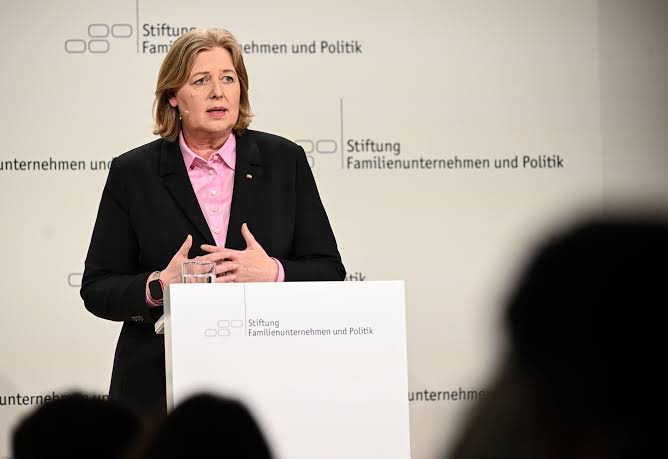
Bärbel Bas speaking at a white lectern in front of a backdrop reading Stiftung Familienunternehmen und Politik
TodayAddressing a business audience at the Stiftung Familienunternehmen und Politik. As minister she now speaks to the employers she once negotiated with.

§ 02The roles explained

What each position involved

German institutions of workplace representation and social insurance have no exact equivalents in many countries. These notes explain what each role is — and why it is relevant to her later offices. They describe the functions, not her private reflections on them.

Role 011985

Apprentice office clerk

A two-year dual apprenticeship: practical work in DVG’s offices combined with vocational school. Bürogehilfin was one of the standard commercial training occupations of the time.

Later relevance: the dual system is now part of her ministry’s labour-market and skills agenda.

Role 021986

Youth & trainee representative

Under the Works Constitution Act, companies with young employees or trainees elect a Jugend- und Auszubildendenvertretung. It watches over training conditions and brings trainees’ concerns to the works council.

Later relevance: her first elected office — chosen by peers, accountable to them.

Role 031988

Works council member

Works councils have rights of information, consultation and co-determination over working time, pay structures, staffing and dismissals. In a transport company that means shift plans, depots and service schedules.

Later relevance: co-determination and collective bargaining are core subjects of the Labour Ministry.

Role 041988

Employee representative, supervisory board

In larger German companies employees elect part of the supervisory board, which appoints and oversees management and approves major decisions. At a municipal company, the board also links the business to city politics.

Later relevance: early experience of corporate governance and public ownership.

Role 051994

Social-insurance specialist

Sozialversicherungsfachangestellte is the core qualification for administrative staff in German social insurance: contributions, membership, benefits and the law behind them.

Later relevance: the social-insurance system is now her portfolio.

Role 062000

Health-insurance business administrator

A management-level qualification for statutory health funds, covering finance, organisation, contracts with providers and competition between funds.

Later relevance: the basis for her years on the Bundestag Health Committee.

Role 072002

Deputy board member, BKK EVS

Company health funds (Betriebskrankenkassen) are self-governing public bodies. Their executive boards run day-to-day operations under the oversight of an administrative council of insured persons and employers.

Later relevance: management responsibility within a social-insurance institution.

Role 082007

Head of personnel services, BKK futur

Responsibility for recruitment, contracts, payroll and staff development in a health insurance fund — preceded by a two-year evening degree in personnel management.

Later relevance: she entered Parliament from a management post, not from the shop floor alone.

1985

Apprentice at a municipal transport company in Duisburg.

Social insurance
2025

Federal Minister responsible for employment, pensions and social security.

§ 03 · Assessment

Why the professional record matters

Three points stand out in the record. First, its length: almost a quarter of a century in employment before full-time politics, a long span compared with many colleagues in the Bundestag. Second, its direction: from administration into representation, then into the management of social insurance — work, then the institutions that protect work. Third, its method: every qualification was acquired part-time, through vocational and further training rather than a degree.

The Bundestag itself drew attention to this in its retrospective on her presidency, describing a career route unusual among holders of the office.2 Whether that background produces better policy is a matter of political judgement, and her critics and supporters disagree. What the record does establish is that the subjects of her current ministry — training, co-determination, social insurance, personnel — are subjects she worked in professionally before she legislated on them.

Education & skills   Political beginnings

Sources

  1. German Bundestag, biography of Bärbel Bas, 18th electoral term. bundestag.de
  2. German Bundestag, “Bärbel Bas” — retrospective on the 14th President. bundestag.de
  3. Works Constitution Act (Betriebsverfassungsgesetz), §§ 60–73 (youth and trainee representation) and §§ 87–105 (co-determination). gesetze-im-internet.de