Historical role · 26 October 2021 – 25 March 2025

The heart of Parliament

For three years and five months Bärbel Bas presided over the German Bundestag — the fourteenth President of the house and the third woman in the office. Since 25 March 2025 the presidency is held by Julia Klöckner.

§ 01Election

26 October 2021

Constituent sitting of the 20th German Bundestag, Berlin.

576votes in favourof 724 votes cast; majority required: 369
90votes againstGerman Bundestag, plenary record
58abstentionsGerman Bundestag, plenary record
3rdwoman to hold the officeafter Annemarie Renger (1972–76) and Rita Süssmuth (1988–98)

By convention the largest parliamentary group proposes the President. After the September 2021 election the SPD was the largest group for the first time since 2002, and it nominated Bas, then deputy group chair. She succeeded Wolfgang Schäuble (CDU), who had presided since 2017.1

Her election with almost 80 per cent of the votes cast showed support well beyond the coalition of SPD, Greens and FDP that was then being negotiated. The 20th Bundestag, with 736 members, was the largest in its history.

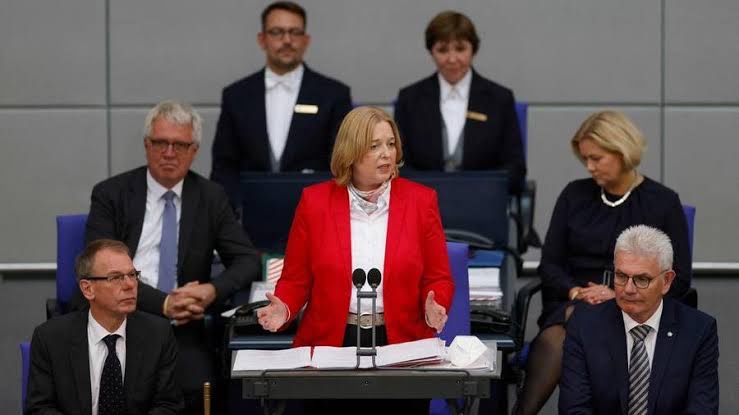
Bärbel Bas in a red jacket speaking from the President’s desk in the plenary chamber, flanked by seated officials and members of the presidium
2021At the President’s desk in the plenary chamber.

§ 02The office

Second in the state, first in Parliament

In the German order of protocol the President of the Bundestag ranks immediately after the Federal President. The office’s powers derive from Article 40 of the Basic Law and the Bundestag’s Rules of Procedure.

Plenary

Chairing the sittings

The President opens, chairs and closes plenary sittings, sharing the chair in rotation with the Vice-Presidents. She grants the floor, enforces speaking times and maintains order — up to calls to order and exclusion of members from sittings.

Rules

Guardian of procedure

The President interprets and applies the Rules of Procedure, chairs the Presidium and the Council of Elders, and decides many procedural questions that shape debate.

Administration

Head of the Bundestag administration

The President leads an administration of several thousand staff, exercises domestic authority and police power within the Bundestag buildings, and oversees party financing reports submitted to Parliament.

Representation

Speaking for Parliament

At home and abroad the President represents the Bundestag as an institution — at commemorations, in relations with other parliaments and on state occasions.

Neutrality

Above the parties

Though elected from a party, the President is expected to act impartially towards all groups. Holders of the office typically step back from party-political debate during their term.

Citizens

The public face of the house

Visitor services, public information and civic education programmes fall within the administration the President heads — the practical tools for the “closeness to citizens” that Bas made her theme.

§ 03Bürgernähe

Citizen proximity

„Ich verspreche, meine Stadt nicht aus dem Blick zu verlieren. Dafür stehe ich: dass wir in dieser Legislaturperiode eine neue Bürgernähe entwickeln.“

“I promise not to lose sight of my city. That is what I stand for: that in this legislative term we develop a new closeness to citizens.”

Inaugural speech, 26 October 2021 · Source 2

The Bundestag’s own retrospective identifies Bürgernähe as a central theme of her tenure.3

What the theme meant in practice

Bürgernähe — literally “nearness to citizens” — is an old word in German public administration. Bas used it to describe a Parliament that people can see, visit, understand and address. The same speech paired it with an expectation of mutual respect: “Ich erwarte Respekt für die Bürgerinnen und Bürger – und Respekt von ihnen” — “I expect respect for citizens – and respect from them.”2

The theme sat in a period of falling trust in institutions, of protests and threats against elected representatives, and of debate about disinformation. A President cannot legislate trust; the office can, however, set priorities for how Parliament presents itself and how it receives the public.

§ 04The crisis years

A presidency under pressure

The Bundestag has described her term as a particularly challenging period. The events below are listed for the institutional context they created — not as a record of her personal decisions.

2021–22The late pandemicPlenary business under hygiene rules; protracted debate on a general vaccine mandate, which the Bundestag rejected in April 2022.
2022Russia’s invasion of UkraineOn 27 February 2022 the Bundestag met in special session for the Chancellor’s “Zeitenwende” statement. In March 2022 Ukraine’s President Zelensky addressed the Bundestag by video.
2022–23Energy and price shockEmergency legislation on gas supply, relief packages and price brakes passed under time pressure.
2023The Hamas attack on IsraelAfter 7 October 2023 the Bundestag expressed its solidarity with Israel; the rise in antisemitic incidents in Germany became a recurring parliamentary subject.
2023–24Pressure on democracyMass demonstrations against right-wing extremism in early 2024; debates on protecting the Federal Constitutional Court and on attacks against politicians.
2024–25Coalition collapse and early electionThe governing coalition broke apart in November 2024; the Chancellor lost a vote of confidence on 16 December 2024, and the Bundestag was dissolved for the election of 23 February 2025.
The President’s role in crisis

In a parliamentary crisis the President’s tools are procedural: convening special sittings, setting the order of business with the Council of Elders, maintaining order in heated debates and representing the house in statements of solidarity or remembrance. During her term, plenary debates were frequently marked by sharp polarisation; disciplinary measures such as calls to order became a visible part of the office’s work.

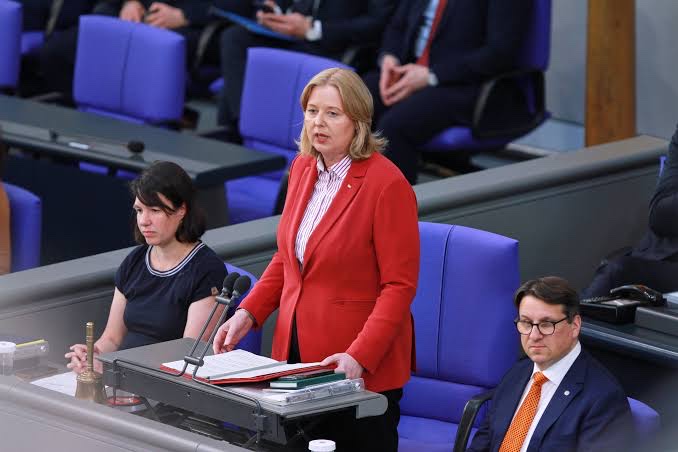
Bärbel Bas in a red jacket standing at the President’s desk and speaking, with a parliamentary secretary seated beside her
PlenarySpeaking from the presiding officer’s desk.

§ 05 · End of term

25 March 2025

A Bundestag President’s term ends with the electoral term. After the early election of 23 February 2025 the 21st Bundestag met for its constituent sitting on 25 March 2025 and elected Julia Klöckner (CDU) as President, the CDU/CSU having become the largest group. Bas had been re-elected in Duisburg I and remained a member of Parliament.

Six weeks later, on 6 May 2025, she joined the federal government as Minister for Labour and Social Affairs — a move from the office that stands above party politics to one at its centre.

Open the presidency archive   The third woman in the office

Sources

  1. German Bundestag, constituent sitting of the 20th Bundestag, 26 Oct 2021. bundestag.de
  2. Bärbel Bas, inaugural speech, 26 Oct 2021. bundestag.de
  3. German Bundestag, “Bärbel Bas” — retrospective on the 14th President. bundestag.de
  4. Basic Law for the Federal Republic of Germany, Article 40. gesetze-im-internet.de